


Blog

10 Best Plastic Compounds for Global Buyers?

Choosing a compound for plastic is not a simple search for the lowest price. The right grade must match the part, process, and service environment. A housing near a warm motor needs different properties from flexible packaging or a water-resistant fitting. Small differences matter.

This guide compares ten widely used compound families, including polypropylene, polyethylene, ABS, polycarbonate, polyamide, PET, POM, PVC, TPU, and glass-filled grades. Each offers trade-offs in strength, flexibility, heat resistance, chemical exposure, appearance, and cost. No single option suits every buyer. That sounds obvious, but it is easy to overlook when supplier data sheets use different test methods.

For global purchasing teams, a useful review goes beyond resin names. Check the exact grade, technical data, processing guidance, color options, and consistency between sample and production batches. Ask suppliers about lead times and whether they can provide supporting documentation for your application. Then test parts under realistic conditions. A neat sample may behave differently after molding, storage, or repeated use.

There is no perfect shortlist. Some grades are harder to process, and some performance claims need verification for the intended design. The comparisons ahead are a starting point, not a substitute for engineering review. Clear specifications and direct questions can help buyers narrow choices with fewer surprises.
10 Best Plastic Compounds for Global Buyers?

What Plastic Compounds Are and How They Differ

A plastic compound is a polymer resin blended with ingredients that change how it processes or performs. These may include colorants, glass fibers, mineral fillers, stabilizers, or impact modifiers. The base polymer sets a starting point; the formulation shapes the final behavior. Two polypropylene compounds, for example, can differ in stiffness, melt flow, color, and resistance to heat. They may look similar as pellets. They are not interchangeable.

This distinction matters in a market producing materials at enormous scale. The OECD’s Global Plastics Outlook reported 460 million tonnes of global plastic production in 2019. PlasticsEurope’s Plastics – the Fast Facts 2023 estimated 400.3 million tonnes in 2022. The figures use different years and reporting approaches, so direct comparison needs care.

Buyers should compare compound data under consistent test conditions, including tensile strength, impact resistance, density, and processing temperature. A tidy datasheet is not the whole story. Mold geometry, moisture, and processing settings can alter results in real production.

Compounds are often grouped by polymer family, reinforcement, or application, but those labels can hide meaningful formulation differences. One overlooked detail can become a cracked clip or a warped panel. That distinction is easy to blur.

Key Criteria for Comparing Compounds Across Global Markets

Comparing plastic compounds across global markets starts with the application, not the catalogue. A compound used in a warm, humid warehouse may behave differently after months of outdoor exposure. Buyers should compare tensile strength, impact resistance, melt flow, density, and heat performance using the same test methods. Ask for test conditions, not just headline values. A number without its method is hard to trust.

Scale matters, too. PlasticsEurope’s 2024 report estimates global plastics production at 413.8 million tonnes in 2023, but this figure covers plastics broadly, not specific compounds. The OECD’s Global Plastics Outlook projects that plastic use could nearly triple by 2060 under current policies. These figures show a large, diverse market; they do not identify the right grade for a particular part. That distinction matters. Buyers should also check batch-to-batch consistency, recycled-content documentation, colour stability, packaging, and lead times at the destination. A spreadsheet can still mislead. Request samples and test them under realistic processing settings, including the local machine and drying conditions. There is no perfect comparison: sometimes the available data are incomplete, and that should be recorded rather than quietly ignored.

10 Plastic Compounds for Common Industrial and Consumer Needs

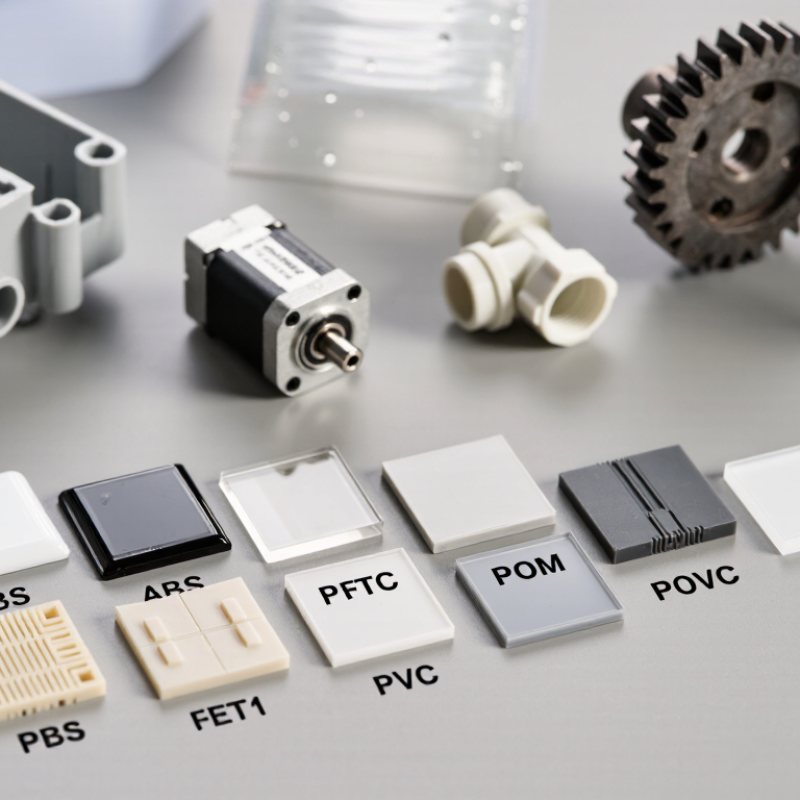
Plastic compounds serve different needs, from flexible packaging to durable machine parts. PlasticsEurope reported global plastics production of 413.8 million tonnes in 2023; the scale makes material selection consequential. Ten common choices are polypropylene (PP) for containers, polyethylene (PE) for films and pipes, PVC for cable insulation, and PET for bottles and fibers. ABS suits housings, polycarbonate (PC) transparent guards, polyamide (PA) gears, POM precision components, PBT electrical parts, and TPU flexible seals. These are starting points, not guaranteed specifications.

The base polymer is only part of the decision. Fillers, stabilizers, impact modifiers, and colorants can change stiffness, heat resistance, appearance, and processing behavior. OECD’s Global Plastics Outlook estimated that only 9% of plastic waste generated in 2019 was ultimately recycled. That figure is a reminder to consider product lifespan and end-of-life options, not just purchase price. A resin that performs well in a catalog may still fail after repeated heat, moisture, or impact exposure. Small details matter.

Tips: Match the compound to actual operating conditions, then test molded or extruded samples. Check tolerances, chemical contact, temperature cycles, and recycled-content requirements with the supplier. Ask for a current technical data sheet and verify claims against recognized test methods. A quick trial helps, but it does not replace long-term testing; that distinction is easy to overlook.

10 Best Plastic Compounds for Global Buyers? - 10 Plastic Compounds for Common Industrial and Consumer Needs
Plastic compound Typical density (g/cm³) Key characteristics Common applications Typical processing Selection considerations
Polypropylene (PP), impact-modified Approximately 0.90–0.91 Low density, good chemical resistance, fatigue resistance, and a useful balance of stiffness and impact performance. Reusable containers, appliance components, automotive interior parts, caps, and household goods. Injection molding, extrusion, and blow molding. Impact performance can decrease in cold conditions. UV exposure may cause degradation unless the formulation includes suitable stabilization.
High-density polyethylene (HDPE) Approximately 0.94–0.97 Good moisture and chemical resistance, toughness, and a relatively high strength-to-weight ratio. Bottles, crates, storage bins, tanks, pipes, and packaging products. Blow molding, extrusion, and injection molding. Stiffness and impact properties depend on grade and temperature. Outdoor products generally require appropriate UV stabilization.
Low-density polyethylene (LDPE) Approximately 0.91–0.93 Flexible, lightweight, moisture-resistant, and generally easy to process. Film packaging, squeeze bottles, flexible lids, liners, and wire or cable insulation. Film extrusion, extrusion coating, and blow molding. Its flexibility and toughness are useful in packaging, but it is less stiff than HDPE and may not suit load-bearing parts.
Rigid polyvinyl chloride (PVC-U) Approximately 1.35–1.45 Rigid, weatherable in suitable formulations, and resistant to many acids, alkalis, and salts. Building profiles, conduit, pipe, fittings, and equipment housings. Extrusion and injection molding. Thermal processing requires careful control because PVC can degrade if overheated. Check local requirements for additives and end-of-life handling.
Flexible polyvinyl chloride (PVC) Approximately 1.15–1.35, depending on formulation Can be formulated across a wide range of flexibility; offers good electrical insulation and abrasion resistance in many grades. Cable jackets, flexible tubing, flooring, seals, and protective coverings. Extrusion, calendaring, and injection molding. Properties depend strongly on plasticizer and stabilizer selection. Confirm chemical compatibility, migration requirements, and applicable regulations.
Acrylonitrile butadiene styrene (ABS) Approximately 1.03–1.08 Good impact strength, dimensional stability, surface finish, and ease of molding. Appliance housings, electronic enclosures, toys, automotive trim, and consumer-product components. Injection molding and extrusion; some grades are suitable for thermoforming. Standard grades have limited resistance to prolonged UV exposure and certain solvents. Choose a suitable grade or protective finish for outdoor use.
Polycarbonate/ABS blend (PC/ABS) Approximately 1.10–1.20 Combines impact performance and heat resistance from PC with the processability and surface quality associated with ABS. Electronic housings, instrument panels, appliance parts, and interior vehicle components. Injection molding and, for selected grades, extrusion. Heat resistance, impact performance, and flame behavior vary by formulation. Verify chemical compatibility and required fire-performance ratings.
Glass-fiber-reinforced polyamide 6 (PA6-GF) Approximately 1.30–1.45, depending on glass content High stiffness and strength for its weight, with improved dimensional stability compared with unreinforced PA6. Brackets, gears, power-tool parts, under-hood components, and structural housings. Primarily injection molding; selected grades are also extruded. Polyamide absorbs moisture, which can affect dimensions and mechanical properties. Glass fibers may increase tool wear and create directional shrinkage.
Polyoxymethylene (POM, acetal) Approximately 1.39–1.43 Low friction, good wear resistance, stiffness, and dimensional stability in many precision applications. Gears, clips, bearings, pump components, fasteners, and precision mechanisms. Injection molding and extrusion. Not suitable for every chemical environment; strong acids and oxidizing agents can attack POM. Design for its grade-specific shrinkage and temperature limits.
Thermoplastic polyurethane (TPU) Approximately 1.10–1.25, depending on formulation Flexible and tough, with good abrasion resistance and elastic recovery across a range of hardness grades. Wheels, seals, cable jackets, footwear components, protective covers, and flexible tubing. Injection molding, extrusion, and blow molding for suitable grades. Choose polyester- or polyether-based chemistry according to the moisture, hydrolysis, oil, and chemical exposure expected in service.
Density figures are representative ranges, not specifications. Actual properties vary by formulation, reinforcement level, processing conditions, and test method; consult the relevant grade data and applicable regulations before use.

How Applications and Processing Methods Shape Material Choice

“Best” depends on what a part must do. A thin packaging film needs flexibility and reliable sealing. A pump housing may need chemical resistance and dimensional stability. For a snap-fit enclosure, impact resistance matters more than a polished data-sheet number. Small details matter.

Processing changes the result. Glass-filled compounds can stiffen a bracket, but fibers may affect surface finish and mold wear. Nylon gears can perform well under load, yet absorbed moisture can change their dimensions. Drying, melt temperature, mold temperature, and cooling time all influence the finished part. Even wall thickness matters. A material that runs smoothly in one mold may create defects in another.

Start with the application’s real conditions: temperature, load, contact with fluids, and expected service life. Then check the grade’s technical data and confirm suitable processing windows with the compound supplier. A small trial using the intended machine and mold can reveal warping, short shots, or brittle weld lines before production scales up. It is easy to overvalue a single test result. That can mislead. Compare samples under realistic conditions, and record settings as carefully as results. Buyers may also need to verify that material documentation matches the destination market and the finished product’s requirements. A neat chart cannot replace a production trial.

How Buyers Evaluate Suppliers, Quality, and International Compliance

Global buyers should compare plastic compounds by performance in the finished part, not by resin name alone. A polypropylene grade for a warm appliance housing may need different impact strength and flame behavior than one used for a thin packaging component. Ask suppliers for current technical data, batch-level certificates, and test methods. Numbers matter. PlasticsEurope’s Plastics—the Fast Facts 2024 report estimates global plastics production at 413.8 million tonnes in 2023. With such a broad supply base, consistent specifications help buyers compare offers fairly.

Supplier checks should cover process control and traceability. Request samples from more than one production lot, then test moisture, color, melt flow, and mechanical properties against agreed limits. A certificate is useful, but it cannot replace testing of the actual compound. OECD’s Global Plastics Outlook (2022) reports that global plastic waste reached 353 million tonnes in 2019; material selection and end-of-life claims therefore deserve careful scrutiny. For international sales, confirm that documentation matches the destination market and intended application, including chemical disclosures and applicable conformity requirements. Requirements vary by product and country.

Tips: Put tolerances, test standards, packaging, and change-notification rules in the purchase specification. Ask for evidence. Keep a retained sample from each approved lot. One practical weakness: buyers sometimes accept a low-cost sample without checking whether the supplier can reproduce its color and flow at production scale. Don’t skip that check.

Register now