



Blog

7 Tips for Choosing the Best Strut Channel Machine?

Choosing the right Strut Channel Machine is more than comparing prices or browsing attractive photographs. The machine must match your channel dimensions, material thickness, production volume, and required tolerances. A 41 x 41 millimeter channel may look simple, yet its bends, holes, and finished length demand precise coordination. Small errors can create fitting problems during installation.

Industry consultant Michael Chen offers a practical reminder: “A reliable roll-forming line should serve the channel design, not force the design to follow the machine.” That idea deserves careful attention. Buyers should examine roll tooling, punching accuracy, decoiler capacity, line speed, changeover time, and after-sales support. Floor space and electrical requirements also matter. An impressive machine can become an expensive obstacle if your workshop cannot operate it efficiently.

This guide presents seven useful tips for selecting a Strut Channel Machine with fewer assumptions. It considers real production details, including galvanized steel scratches, inconsistent hole spacing, noisy cutting stations, and difficult maintenance access. These details are not glamorous. They affect rejected products and operator confidence.

There is no perfect choice.

A faster line may not be better for short runs. A cheaper machine may demand more adjustments. Even experienced buyers can overlook tooling storage or future product changes. You may need to question the original specification before signing an order. Careful comparison, sample testing, and a direct discussion with the manufacturer can reveal weaknesses early. The goal is not simply to purchase equipment. It is to build a stable, repeatable, and commercially sensible production process.
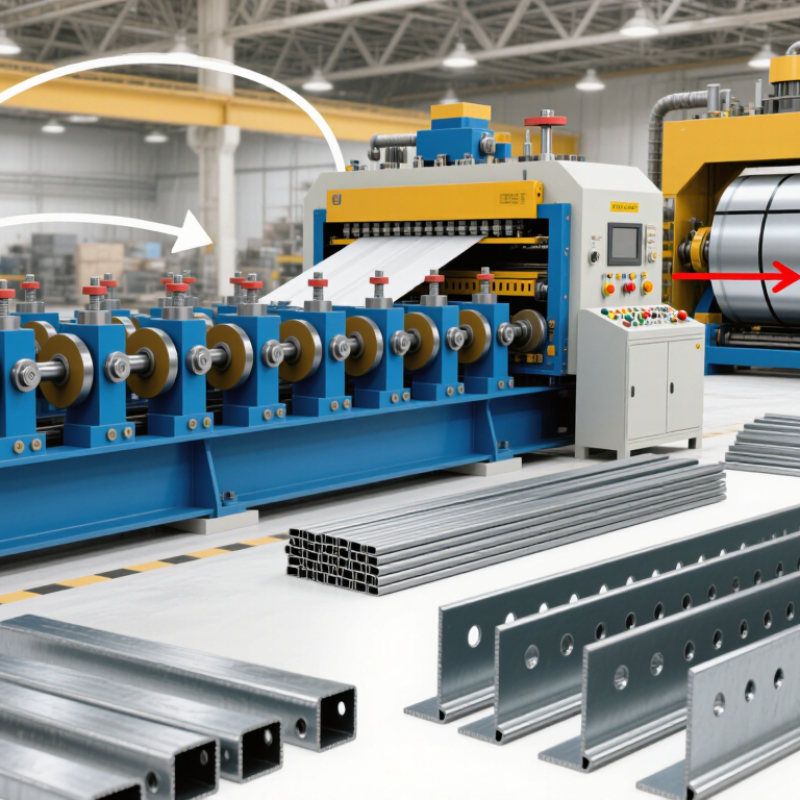
7 Tips for Choosing the Best Strut Channel Machine?

Define Channel Profiles, Steel Grades, and Gauge Before Comparing Machines

Define Channel Profiles, Steel Grades, and Gauge Before Comparing Machines

Choosing the best strut channel machine starts with the finished channel, not the machine catalog. Define the profile first: 41 x 41 mm, 41 x 21 mm, or a custom section. Record flange shape, hole pattern, slot length, pitch, and corner radius. A small radius change can affect roll tooling, springback, and final fit.

Steel grade comes next.

AISI S100 covers structural steel design principles, but it does not replace material certification. Confirm yield strength, coating, and surface condition with mill certificates. The World Steel Association reported approximately 1.89 billion tonnes of crude steel production in 2023, showing the scale of steel supply, but volume does not guarantee consistent forming behavior. Gauge needs equal attention. Measure actual thickness, not only the nominal label. Galvanized coating and tolerance can alter the result.

Then match the machine to these inputs.

Compare forming stations, drive capacity, entry guidance, cutoff accuracy, and quick-change tooling. Ask for trial production using your real coil. I have seen buyers compare speed while ignoring profile recovery after cutting. That assumption is risky. A machine producing 30 meters per minute is not efficient if the channel twists or misses dimensional tolerances. Request sample measurements, repeatability data, and maintenance records. Leave room for doubt; future steel grades may behave differently.

Match Roll-Forming Capacity to 41 mm Strut and 1.5–2.5 mm Sheet Targets

7 Tips for Choosing the Best Strut Channel Machine?

Match Roll-Forming Capacity to 41 mm Strut and 1.5–2.5 mm Sheet Targets

Choosing the right strut channel machine starts with the finished profile, not the machine brochure. For a 41 mm strut, confirm the internal width, lip geometry, and allowable tolerance. Small dimensional errors can make a channel difficult to join or unsafe to install. Measure twice. Ask for sample profiles, not only photographs. A production trial should use your specified steel grade and 1.5–2.5 mm sheet range. This reveals forming stability, surface marks, and springback under real conditions.

Evaluate roll-forming capacity across the whole thickness range. A machine that handles 2.5 mm may still struggle at 1.5 mm. Check the entry guide, roll stations, drive torque, and straightening section. These parts influence feeding accuracy and profile repeatability. Confirm coil width, maximum coil weight, line speed, and cut-to-length tolerance before purchasing. The 41 mm target may require different tooling than a visually similar channel. Do not guess.

Reliable equipment also needs practical maintenance access. Inspect bearing protection, lubrication points, electrical documentation, and emergency stopping functions. Request recorded test data, inspection criteria, and a clear spare-parts list. Experienced operators should review changeover time, because slow tooling changes reduce real output. I would also test short and long runs; both can expose different problems. Perfect results on one coil are encouraging, but not conclusive. Leave room for correction.

7 Tips for Choosing the Best Strut Channel Machine

Match the roll-forming capacity to the required 41 mm strut profile and the complete 1.5–2.5 mm sheet-thickness range. A suitable machine should be configured for the maximum target thickness while maintaining stable forming across the minimum and nominal gauges.

Check Coating Compatibility with ASTM A653 G90: 275 g/m² Zinc

When choosing the best strut channel machine, coating compatibility deserves careful attention. ASTM A653 G90 steel carries approximately 275 g/m² of zinc across both surfaces. This is coating mass, not coating thickness. Confusing these values can lead to incorrect tooling decisions.

Ask for the steel mill certificate before testing the machine. Confirm the coating designation, base-metal grade, thickness tolerance, and coil width. During a trial run, inspect the channel around tight corners and punched areas. White powder, exposed steel, or peeling zinc may indicate excessive forming pressure. Small defects matter.

Use properly aligned entry guides and polished rolls. Keep roll gaps consistent, because uneven pressure can mark the galvanized surface. A larger forming radius may reduce cracking, although it can slightly change the channel profile. Check the finished dimensions with a gauge, then inspect damaged areas visually and with suitable coating measurements. The machine should maintain profile accuracy without scraping the zinc layer.

Do not rely only on a supplier’s speed claim. Run production-grade G90 material through several samples. Watch the surface under bright side lighting. I have found that a machine can form the profile correctly while quietly damaging the coating. That detail is easy to miss. Recheck punch clearance, line speed, and roll alignment after the trial, since changing one setting may affect the entire surface finish.

Verify Accuracy, Changeover Time, and Line Speed Before Purchase

7 Tips for Choosing the Best Strut Channel Machine

A strut channel machine should prove its accuracy before purchase, not merely promise it. Ask the supplier to run your actual material, thickness, and profile dimensions. Measure hole spacing, flange angles, and channel length with calibrated tools. Small errors can cause serious fitting problems during installation. Check repeatability across several batches, not only one impressive sample. I once accepted a trial based on a single coil, and that assumption was wrong. Request inspection records and clear tolerance data. Reliable documentation matters.

Changeover time directly affects daily output. Use a stopwatch during trials, including tooling removal, adjustment, and the first acceptable piece. A quick change is not useful if operators need repeated corrections. Test different profiles and material gauges under realistic conditions. Then compare the advertised line speed with the speed of saleable production. Forming speed may look high while setup delays create a bottleneck. Review acceleration, coil handling, cutting, and punching coordination. Ask whether the control system stores proven settings for future jobs. Operators should understand the interface without guessing. Keep the process simple. Also examine maintenance access, spare-part availability, and technical training. A fast machine with difficult servicing can lose more hours than it saves. Consider noise, guarding, and emergency controls during the factory visit. These details often reveal the manufacturer’s practical experience.

Assess OEE, Tooling Life, Service Support, and EN 60204-1 Compliance

7 Tips for Choosing the Best Strut Channel Machine

Assess OEE from real production records, not only the supplier’s estimate. Tip 1: Check availability, performance, and quality separately. A high speed means little if changeovers consume every morning. Tip 2: Request sample data from similar channel sizes. Inspect rejected parts, downtime notes, and operator comments. A perfect OEE number can hide weak maintenance habits.

Tip 3: Examine tooling life under your actual steel thickness and coating. Ask how wear is measured, repaired, and documented. Tip 4: Confirm adjustment access and replacement time. Small details matter. A damaged punch should not stop production for several days. Tip 5: Review preventive maintenance instructions, spare-part availability, and technical response times. Service support is part of machine value, not an optional extra. I have seen dependable equipment lose productivity because a simple sensor waited weeks for replacement.

Tip 6: Ask whether the electrical design supports EN 60204-1 requirements. Review emergency stops, protective bonding, control-panel labeling, cable routing, and documentation with a qualified professional. Compliance should be verified for the final machine configuration and installation. Tip 7: Test operator usability before purchase. Guards, access doors, diagnostics, and reset procedures should be clear on a noisy shop floor. Do not ignore training quality. An experienced operator may reveal risks that a factory demonstration misses. That feedback is worth more than polished slides.

7 Tips for Choosing the Best Strut Channel Machine? — Assess OEE, Tooling Life, Service Support, and EN 60204-1 Compliance
No. Selection Area What to Assess Practical Data or Benchmark Evidence to Request Decision Check
1 Measure OEE, Not Just Rated Speed Evaluate availability, performance, and quality under the intended production mix. OEE is calculated as: Availability × Performance × Quality. Record planned production time, downtime, ideal cycle time, total output, and good output. Example: 90% availability × 85% performance × 98% quality = 75.0% OEE. Factory acceptance-test results, sample production logs, downtime categories, and a clearly defined cycle-time basis. Compare suppliers using the same material, profile dimensions, tooling setup, batch size, and quality requirements.
2 Verify Material and Forming Capability Check whether the machine can process the required steel grade, thickness range, strip width, hole pattern, channel profile, and cut-to-length tolerance. Confirm published limits in millimetres. Do not treat maximum thickness, maximum width, and maximum line speed as interchangeable specifications. Validated trial parts, dimensional inspection reports, material certificates, tooling drawings, and a written list of approved material grades. Require production samples made from the actual coil material and the most demanding profile in the purchase specification.
3 Assess Tooling Life and Changeover Cost Review roll-forming tooling materials, heat treatment, surface condition, adjustment method, wear monitoring, and the time required for profile changes. Tool life must be stated for a defined material, thickness, lubrication condition, profile, and acceptance limit. A life claim without these conditions is not comparable. Tooling material and hardness records, wear photographs or inspection data, spare-tool pricing, setup instructions, and documented changeover time. Select the design with predictable wear, repeatable setup, accessible replacement parts, and a total tooling cost calculated over the planned production volume.
4 Check Electrical Safety and EN 60204-1 Alignment Review the machine’s electrical equipment, protective bonding, disconnecting means, emergency-stop functions, control circuits, wiring identification, documentation, and verification tests. EN 60204-1 covers electrical equipment of machines. Compliance should be assessed against the applicable edition and the complete machine risk assessment; it is not automatically proven by a component marking. Electrical schematics, risk assessment, protective-conductor continuity results, insulation-resistance results, functional test records, emergency-stop validation, and the declaration or conformity documentation required for the installation location. Have a qualified electrical professional review the design before purchase and verify the completed machine during acceptance testing.
5 Evaluate Service Response and Spare Parts Assess remote diagnostics, technician availability, software support, spare-parts stocking, escalation procedures, and support across the machine’s expected operating life. Define contractual targets such as response acknowledgement within one business day, critical-parts quotation within two business days, and documented escalation for recurring faults. Service-level agreement, spare-parts list with lead times, preventive-maintenance schedule, troubleshooting guides, training plan, and support contact process. Score support using measurable response times and parts availability rather than general statements such as “global service.”
6 Calculate Total Cost of Ownership Include purchase price, installation, commissioning, energy, compressed air, consumables, tooling, maintenance labour, spare parts, scrap, training, and planned downtime. Use a common evaluation period, such as five years, and compare cost per good metre or cost per finished channel, not only the initial machine price. Itemised quotation, utility requirements, energy data under defined load conditions, maintenance intervals, consumable prices, and warranty exclusions. Prefer the machine with the lowest verified cost per good product when safety, quality, capacity, and compliance requirements are met.
7 Use a Documented Acceptance Test Set measurable criteria for speed, dimensional accuracy, hole position, cut length, surface quality, changeover, safety functions, and operator training. Define the sample size, material condition, inspection method, allowable tolerances, uptime window, and treatment of rework and rejected parts before the machine is shipped. Approved acceptance-test protocol, inspection equipment list, calibration records, signed test results, punch-list process, and final manuals in the required language. Link final payment or formal acceptance to objective results, complete documentation, correction of safety issues, and successful production of representative parts.
Important: OEE percentages, tooling life, service targets, and production tolerances are not universal values. They should be confirmed through a controlled trial using the actual material, profile, operating conditions, and acceptance criteria.
Register now