



Blog
What Is a Pallet Conveyor and How Does It Work?
A Pallet Conveyor is a powered material-handling system designed to move loaded pallets through warehouses, factories, and distribution centers. It uses rollers, chains, motors, sensors, and control software to transport heavy loads along a planned route. Some systems move pallets continuously. Others stop, release, or accumulate them at specific stations.
Richard Muther, a respected authority on plant layout and material handling, stated, “The best material handling is no handling.” This principle explains why a well-designed Pallet Conveyor should reduce unnecessary movement, waiting, lifting, and manual intervention. It should not simply move pallets faster. It should move them safely, accurately, and at the right time.
Inside a typical system, sensors detect pallet position and communicate with a programmable logic controller. The controller starts, stops, diverts, or merges pallet flow. Roller conveyors suit many stable loads, while chain conveyors can handle pallets with uneven undersides. Transfers may turn pallets ninety degrees or shift them between conveyor lines.
The details matter.
A small mismatch in pallet dimensions can cause jams. Poor sensor placement can create gaps or unexpected stops. An oversized motor may waste energy, while an undersized one may struggle under peak loads. These practical weaknesses deserve attention.
This guide explains what a Pallet Conveyor is, how its main components work, and where different designs perform best. It also considers maintenance, safety, load stability, and layout planning. The goal is not to present one perfect solution. Real facilities have constraints, and good conveyor design begins by acknowledging them.
What Is a Pallet Conveyor?
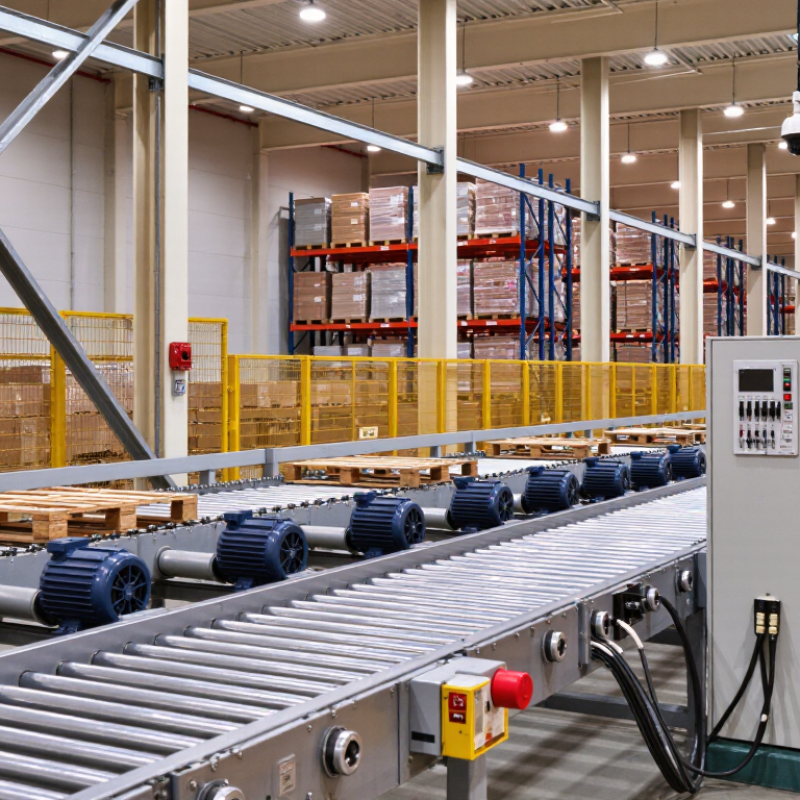
A pallet conveyor is a powered material-handling system that moves loaded pallets through a warehouse, factory, or distribution center. It uses rollers, chains, belts, or a combination of these components. Each pallet travels along a planned route, often between storage areas, picking stations, and loading docks. The conveyor frame supports the load, while motors and sensors control movement, spacing, and stopping points.
The working process is practical. A pallet enters through a loading zone and passes sensors that confirm its position. Drive rollers or chains then move it forward at a controlled speed. At a transfer point, a lift, turntable, or chain transfer changes its direction. Operators can connect the system with warehouse software, but software alone cannot correct poor pallet quality. Bent boards, uneven loads, and loose wrapping still cause jams.
Reliable figures support this growing role. The 2024 MHI Annual Industry Report states that 55% of surveyed supply chain professionals planned to increase investment in automation and robotics. Interact Analysis also reported that global warehouse automation revenue was expected to exceed 30 billion dollars by 2027. These figures suggest strong demand, not guaranteed success. A conveyor may improve throughput, yet an unsuitable layout can create new bottlenecks. In field evaluations, checking pallet dimensions, load weight, emergency access, and maintenance space should come before selecting equipment. Small details matter.
What Is a Pallet Conveyor and How Does It Work?
A pallet conveyor is a material-handling system that moves loaded pallets between processing, storage, and shipping areas. Powered rollers, chains, or belts provide the driving force, while sensors and controls regulate pallet spacing and direction.
The chart compares two common pallet footprints used when sizing conveyor frames and support surfaces. Conveyor width, roller spacing, and load support must be selected to safely accommodate the pallet dimensions.
What Are the Main Components of a Pallet Conveyor?
A pallet conveyor moves loaded pallets through a warehouse using powered rollers, chains, or belts. Its main components determine speed, safety, and reliability. The conveyor frame supports the load and keeps the route aligned. Rollers or chains provide the contact surface, while a geared motor supplies controlled movement. Drive sprockets, shafts, and bearings transfer power across each section.
Sensors detect pallet position, height, and spacing. A programmable controller then starts, stops, or redirects movement. Transfer units, lift tables, and turntables connect different conveyor lines. Pallet stops hold loads at picking or inspection points. Side guides reduce drifting, although poor adjustment can still create jams. Safety guarding, emergency stops, and warning devices protect workers near moving parts. MHI’s 2024 Annual Industry Report indicates that robotics and automation adoption may rise from 23% to 45% within five years. That trend increases the need for dependable conveyor controls.
Tips: Match roller capacity to the heaviest pallet, not the average one. Leave access around motors and sensors for maintenance. Test unstable loads before full deployment. A technically correct layout may still fail when pallets vary in size or condition. Measure stopping distance during commissioning. Small details matter. Regularly inspect bearings, chains, photoelectric sensors, and emergency stops. Record recurring faults instead of resetting them blindly. This practical evidence often reveals design weaknesses that drawings miss.
What Is a Pallet Conveyor and How Does It Work? - What Are the Main Components of a Pallet Conveyor?
| Component or Data Dimension | What It Is | Primary Function | Typical Specifications or Characteristics | How It Supports Pallet Movement |
|---|---|---|---|---|
| Pallet Conveyor | A powered or gravity-based material-handling system designed to transport loaded or empty pallets between operational areas. | Moves pallets through manufacturing, warehousing, storage, order-picking, and shipping processes. | Common configurations include roller, chain, belt, turntable, transfer, accumulation, and pallet shuttle conveyors. | Provides a controlled and repeatable route while reducing manual forklift or pallet-jack movement. |
| Pallet Load | The pallet and the goods placed on it. | Defines the required conveyor capacity, dimensions, surface type, and control method. | Important factors include pallet length, width, weight, condition, load stability, and bottom-board configuration. | A compatible pallet base ensures stable contact with rollers, chains, or belts and prevents misalignment. |
| Frame | The structural body that supports the conveyor’s load-carrying and drive components. | Maintains alignment, rigidity, and the correct conveying height. | Usually fabricated from painted or galvanized steel; stainless steel may be used where corrosion resistance or sanitation is required. | Transfers the pallet load to the supports and keeps the conveying surface level. |
| Rollers | Cylindrical rotating elements that contact and carry the pallet. | Support the pallet and provide a low-friction conveying surface. | Roller diameter, spacing, width, bearing type, and load capacity are selected according to pallet weight and bottom construction. | Powered rollers propel the pallet; non-powered rollers allow movement by gravity or external pushing. |
| Chains | Continuous metal strands used as the conveying surface or as a drive connection. | Transfers traction directly to suitable pallet bottom boards or carries heavy loads across demanding sections. | Two or more parallel strands are common; chain type and pitch depend on load, speed, and operating environment. | Provides positive engagement and is often suitable for heavy pallets, transfers, and environments with debris. |
| Drive Motor | An electric motor that supplies mechanical power to the conveyor. | Rotates rollers, sprockets, pulleys, or belts to move pallets. | Motor selection depends on pallet mass, conveyor length, incline, speed, duty cycle, and acceleration requirements. | Converts electrical energy into controlled conveying motion. |
| Gearbox or Gearmotor | A speed-reduction unit connected to the motor and conveyor drive. | Reduces motor speed while increasing usable torque. | The reduction ratio is chosen to achieve the required pallet speed and starting force. | Allows the conveyor to start and move heavy pallets smoothly without overspeeding the drive components. |
| Belts and Sprockets | Belts transmit motion between rotating components, while sprockets engage with chains. | Transfer motor torque to rollers, chains, or other conveyor sections. | Components must be correctly tensioned and aligned to limit slip, wear, noise, and power loss. | Create synchronized motion across the conveying surface. |
| Bearings | Mechanical elements that support rotating shafts, rollers, and drive components. | Reduce friction and maintain smooth rotation under load. | Sealing, lubrication, load rating, and environmental resistance are key selection factors. | Help maintain consistent speed and reduce energy consumption and mechanical wear. |
| Sensors | Devices that detect pallet presence, position, direction, or accumulation status. | Provide feedback for starting, stopping, indexing, spacing, and routing pallets. | Common types include photoelectric, proximity, encoder, and safety-position sensors. | Enable automatic control and help prevent collisions, jams, and incorrect pallet transfers. |
| Control System | The electrical and software-based system that operates the conveyor. | Coordinates motors, sensors, stops, transfers, alarms, and operating sequences. | May include a programmable controller, motor starters or drives, input/output modules, and an operator interface. | Determines when each conveyor zone runs, stops, accumulates, or releases a pallet. |
| Zone Control | A control arrangement that divides a conveyor into independently managed sections. | Controls pallet spacing and allows pallets to accumulate without continuous contact. | Often uses sensors and individual drives or controlled stops for each zone. | Improves throughput, reduces product contact, and limits unnecessary motor operation. |
| Pallet Stops and Positioners | Mechanical devices that stop, locate, or align pallets at designated points. | Provide accurate positioning for inspection, wrapping, loading, picking, or robotic operations. | May be pneumatic, electric, or mechanically actuated and must be rated for the pallet load. | Prevents pallets from passing a workstation and keeps them correctly located during processing. |
| Transfers and Turntables | Modules that change a pallet’s direction, conveyor line, or orientation. | Connect intersecting conveyor paths and support layout flexibility. | Common designs include chain transfers, roller transfers, and rotating turntables. | Moves pallets laterally or rotates them so they can enter another process or storage aisle. |
| Guardrails and Guides | Fixed or adjustable barriers positioned along the conveyor path. | Keep pallets centered and help prevent lateral movement or falls. | Height, spacing, and strength should match pallet dimensions and the expected load behavior. | Improves stability, especially at transfers, curves, inclines, and acceleration points. |
| Safety Devices | Devices designed to protect operators and maintenance personnel. | Stop hazardous motion and provide safe access during abnormal conditions or servicing. | Examples include emergency-stop controls, guards, safety switches, light curtains, and lockout provisions. | Interrupts conveyor operation when a hazard, obstruction, or unsafe access condition is detected. |
| Support Legs and Leveling Feet | Structural supports that hold the conveyor at the required elevation. | Distribute the conveyor load and compensate for uneven floors. | Typically include adjustable feet, bracing, and floor anchoring where required. | Maintain a stable, level conveying surface and reduce vibration during operation. |
| Operating Principle | A coordinated sequence in which the pallet is detected, conveyed, controlled, and released. | Automates the movement of pallets between defined points. | The control system receives sensor signals, activates the appropriate drive or actuator, and stops the pallet at its destination. | Combines mechanical traction, electrical control, sensing, and safety functions into one material-flow system. |
How Does a Pallet Conveyor Move and Control Loads?
A pallet conveyor moves unit loads through a warehouse using powered rollers, chains, or belts. The system transfers pallets from one station to another while controlling speed, spacing, and direction. Powered roller sections rotate beneath the pallet. Photoelectric sensors detect its position. A programmable controller then starts, stops, or diverts each load. This creates controlled movement instead of constant pushing.
Control logic matters more than speed. A zone conveyor can hold one pallet while another moves ahead. This reduces collisions and protects fragile goods. For heavier pallets, operators often use chain-driven sections because chains provide strong traction. The U.S. Occupational Safety and Health Administration stresses guarding moving conveyor parts and using emergency stops. MHI’s 2024 Annual Industry Report also reported that 55% of supply chain leaders were increasing technology investment. That trend supports wider use of sensors and automated material handling.
Tips: Match conveyor capacity to the heaviest pallet, not the average one. Leave space for forks and maintenance access. Test sensors with dark, damaged, and uneven pallets. Small errors matter. A poorly placed sensor may stop an entire line. In practice, perfect flow is rare. Dust, shifting loads, and rushed loading can create faults. Review stoppage data weekly, then adjust speed, zone length, or sensor position. Cite: MHI, 2024 Annual Industry Report; OSHA, Conveyor Safety.
What Types of Pallet Conveyors Are Available?
Pallet conveyors move loaded pallets through warehouses, production areas, and distribution facilities. Their design depends on pallet weight, dimensions, surface condition, and movement requirements. Different conveyor types suit different operating conditions.
Powered roller conveyors are widely used for stable, standardized pallets. Motor-driven rollers carry loads smoothly and can support accumulation zones. Chain conveyors use parallel chains beneath the pallet. They handle heavy loads and pallets with uneven undersides more reliably than rollers. Belt conveyors provide continuous support, which helps with fragile or unstable loads, although belt wear can become a maintenance concern.
Transfer conveyors move pallets sideways between conveyor lines. They often use lift-and-carry mechanisms, chains, or rollers. Turntable conveyors rotate pallets to change direction without manual handling. Gravity roller conveyors rely on a slight slope, reducing energy use. However, they need careful speed control. Otherwise, pallets may collide.
Accumulating conveyors create temporary buffers between workstations. This prevents one stopped process from blocking the entire line. In practice, no conveyor layout is perfect. A system may work on paper but create awkward gaps, noise, or difficult inspection points. Engineers should test real pallets, not only drawings.
Small differences in pallet quality can affect tracking and stopping accuracy. Safety sensors, guarded moving parts, emergency stops, and documented inspections are essential for dependable operation.
Where Are Pallet Conveyors Used?
Pallet conveyors are widely used where heavy, repeated pallet movement must remain controlled. Warehouses use them between receiving docks, storage lanes, picking areas, and shipping doors. Powered rollers move pallets steadily, while sensors detect gaps and stop traffic when a lane becomes full. This reduces forklift travel and keeps workers away from crowded routes. At a loading dock, a pallet can travel from unloading equipment to temporary storage without being lifted repeatedly. Flow changes.
Manufacturing plants also use pallet conveyors between production lines, wrapping stations, inspection points, and finished-goods storage. Distribution centers depend on them for sorting orders by destination or delivery schedule. Cold-storage facilities may use corrosion-resistant components and sealed motors. However, a conveyor design that looks efficient on paper can struggle with damaged pallets, uneven loads, or narrow aisles. Practical site measurements matter. Floor levels, pallet dimensions, traffic patterns, and maintenance access should be checked before installation.
Tips: Keep pallet sizes consistent whenever possible. Add guards near transfer points and emergency stops within easy reach. Clean rollers regularly, especially where dust or loose packaging collects. Test the system with real loads, not empty pallets. A short trial often reveals noise, jams, or awkward worker movements before daily operations begin.