


Blog
Top Plastic Filler Compound Suppliers for Global Buyers
Global buyers need more than a supplier list when evaluating plastic filler compound manufacturers. They need evidence, consistency, and practical performance data. A compound may look competitive on paper, yet fail during extrusion, injection molding, or long-distance storage. Moisture, particle dispersion, calcium carbonate content, carrier resin, and packaging quality can change the final result.
This guide examines leading plastic filler compound suppliers serving international markets. It considers technical capability, production capacity, quality systems, customization, export experience, and communication reliability. Samples matter. So do factory audits. A polished website is not enough.
Polymer specialist Dr. John Scheirs has emphasized, “The performance of a plastic product depends heavily on selecting the right material and processing conditions.” That principle applies directly to filler compounds. A low-cost masterbatch can create surface defects, unstable color, or reduced mechanical strength. Small savings may become expensive waste.
The ranking is not absolute. Buyer priorities differ. Some manufacturers excel in high-loading calcium carbonate compounds. Others focus on talc-filled, mineral-filled, biodegradable, or recycled-resin formulations. Certifications also require careful checking, because documents may vary by product and market.
There is no perfect supplier.
This article provides a practical comparison for importers, distributors, compounders, and manufacturers. It highlights measurable strengths while recognizing areas that still need verification. Buyers should test samples under real production conditions before committing to large orders. That step is often overlooked. It should not be.
What Plastic Filler Compounds Are and Why Global Buyers Use Them
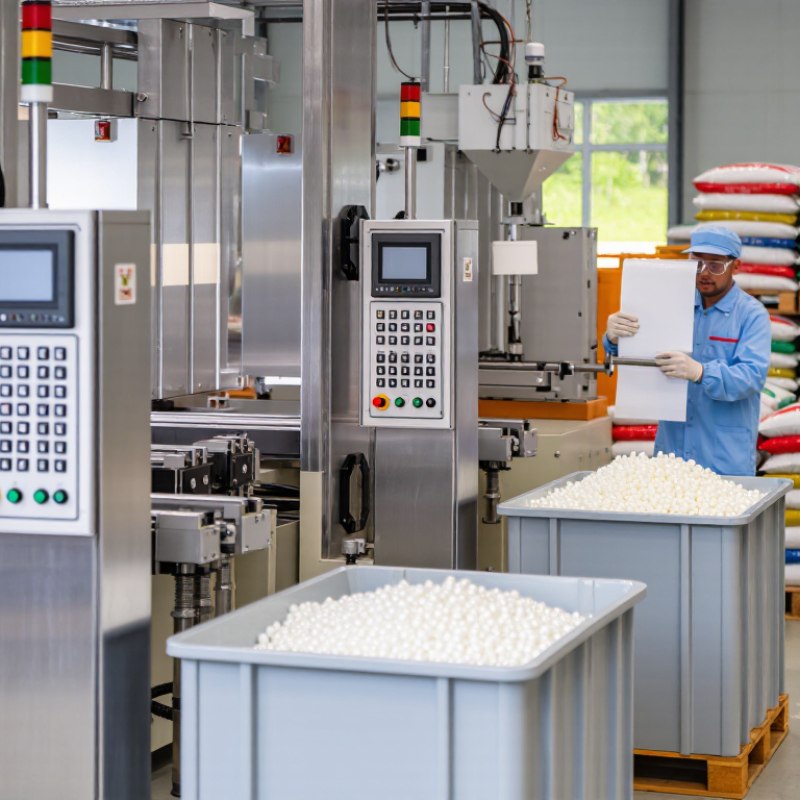
Plastic filler compounds are polymer blends containing minerals such as calcium carbonate, talc, or wollastonite. They are supplied as pellets for easier dosing and consistent processing. During extrusion or injection molding, fillers can improve stiffness, dimensional stability, surface feel, and heat resistance. They may also reduce resin consumption. The trade-off is easy to miss. Excess filler can lower impact strength, create surface defects, or increase equipment wear.
Global buyers use these compounds because plastics demand remains enormous. Plastics Europe reported global production of 413.8 million tonnes in 2023. This scale makes material efficiency commercially important. A carefully selected filler compound can support lighter packaging, rigid household parts, pipes, and automotive components. Industry testing should follow recognized methods, including ASTM D638 for tensile properties and ISO 527 for comparable tensile measurements. Results still depend on moisture control, screw design, filler loading, and cooling conditions.
Purchasing teams should request technical data sheets, safety documentation, particle-size information, and batch consistency records. Ask for production samples. Small differences matter. A compound that performs well in one mold may fail in another. Recent market studies from MarketsandMarkets identify plastic compounding as a continuing growth sector, driven by construction, packaging, transportation, and electrical applications. However, forecasts are not guarantees. Buyers should validate actual cycle time, warpage, odor, recycled content, and final-part strength before approving a long-term supply agreement.
Key Types of Plastic Filler Compounds and Their Material Benefits
Top Plastic Filler Compound Suppliers for Global Buyers
Key Types of Plastic Filler Compounds and Their Material Benefits
Plastic filler compounds help processors reduce resin use, control shrinkage, and tune stiffness. Calcium carbonate is widely selected for polypropylene, polyethylene, and PVC applications. It can improve dimensional stability and lower material cost, although excessive loading may reduce impact strength. Talc offers higher rigidity and better heat resistance, making it useful for automotive housings and appliance components. Particle size matters greatly.
Glass-fiber-filled compounds deliver stronger reinforcement than mineral fillers. They improve tensile strength, fatigue performance, and dimensional control. However, glass fiber can increase abrasiveness during processing and may create a rougher surface. A 2023 industry analysis by Grand View Research estimated the global plastics market at over 600 million tonnes annually, showing the scale of demand for performance-focused compounds. The exact filler ratio still depends on processing equipment and end-use requirements.
Wood-plastic compounds combine polymer with wood flour or agricultural fibers. They provide a textured appearance and can reduce reliance on virgin resin. Their moisture sensitivity remains a practical concern. According to the OECD’s Global Plastics Outlook, global plastic waste reached 353 million tonnes in 2019. This pressure encourages buyers to evaluate recycled-content fillers, but quality consistency is not always perfect. Supplier testing should cover ash content, moisture, melt flow, dispersion, and batch-to-batch color. Small particles matter. Cost savings alone can mislead.
Top Plastic Filler Compound Suppliers for Global Buyers
Key Types of Plastic Filler Compounds and Their Material Benefits
Mineral fillers such as calcium carbonate, talc, and kaolin are widely used to improve stiffness, dimensional stability, opacity, and cost efficiency in plastic compounds. Glass fiber provides strong reinforcement, while wood flour offers a lightweight, bio-based option for selected polymer applications. The density figures shown are representative values for the filler materials and may vary by grade, particle size, surface treatment, and moisture content.
How to Evaluate Plastic Filler Compound Suppliers Worldwide
Global buyers should evaluate plastic filler compound suppliers through evidence, not polished brochures. PlasticsEurope’s Plastics—The Fast Facts 2024 reports global plastics production reached 413.8 million tonnes in 2023. That scale makes consistency essential. Request technical data sheets, safety data sheets, certificates of analysis, and recent batch records. Check melt flow rate, moisture, density, ash content, dispersion, tensile strength, and impact performance. Data beats promises.
Supplier capacity also matters. Ask about production lines, backup equipment, raw material sources, and average lead times. A reliable supplier should explain how it manages calcium carbonate, talc, or other mineral variability. Independent testing can verify these claims. ISO 9001 certification supports process control, but it does not replace product testing. Request samples from different production lots. Compare them under identical processing conditions.
Sustainability deserves careful review. The OECD’s Global Plastics Outlook projects annual plastic waste could nearly triple by 2060 without stronger intervention. Ask whether recycled inputs have traceable origins, stable specifications, and documented contamination controls. Cost comparisons should include freight, moisture variation, rejected batches, and production downtime. I once saw a low-price offer become expensive after inconsistent dispersion caused surface defects. That risk is easy to miss. No scorecard is perfect. Recheck assumptions before signing a long-term supply agreement.
Quality Standards, Certifications, and Testing Requirements
Global buyers should judge plastic filler compound suppliers by verified process control, not polished brochures. The ISO Survey 2023 recorded more than 1.2 million ISO 9001 certificates worldwide, showing certification is common. It is not proof of consistent filler performance. Buyers should check certificate scope, audit dates, laboratory competence, and corrective-action records.
Ask for batch-level testing. Moisture, ash content, particle-size distribution, density, melt flow rate, and filler dispersion directly affect processing. For calcium carbonate or talc compounds, microscopy can reveal agglomerates hidden inside a clean-looking pellet. Accredited laboratories should use recognized ASTM or ISO methods. Test the powder, not only the certificate. A supplier should provide retain samples, signed certificates of analysis, and traceability from mineral source to finished compound.
Environmental and chemical documentation also matters. The OECD Global Plastics Outlook reports that global plastics production reached 460 million tonnes in 2019, increasing pressure for measurable resource efficiency. ISO 14001 certification can support environmental controls, but buyers should still request energy, waste, and recycled-content data. For regulated applications, obtain current declarations for chemical restrictions and food-contact requirements, supported by migration or extraction testing where applicable. A certificate can look reassuring, yet it cannot correct a poorly controlled batch. Some suppliers still report average values instead of actual lot results. That deserves careful questioning.
Choosing the Right Supplier for Cost, Performance, and Logistics
Top Plastic Filler Compound Suppliers for Global Buyers
Choosing a supplier requires more than comparing quoted prices. The landed cost includes resin compatibility, filler loading, packaging, freight, insurance, duties, and potential production losses. A compound priced 6% lower may become more expensive after poor dispersion causes surface defects or blocked filters.
Performance must be verified through controlled trials. Request technical data for calcium carbonate content, moisture, melt flow rate, density, particle size, and color stability. Then test samples on your actual extrusion or injection equipment. PlasticsEurope reported global plastics production of approximately 400.3 million tonnes in 2022, showing the scale of competition and material variation. Small formulation differences can affect thousands of finished parts.
Logistics deserves equal attention. Compare lead times, minimum order quantities, port options, pallet protection, and backup production capacity. The OECD’s Global Plastics Outlook projects plastic waste could nearly triple by 2060, increasing pressure for efficient material use and credible sustainability data. Ask suppliers for batch traceability, test certificates, and documented recycled-content claims. Verify these records independently.
Do not trust a perfect spreadsheet. Real shipments face humidity, customs delays, and damaged bags. A practical supplier should explain corrective actions, not only promise consistency. Quarterly reviews should examine delivery accuracy, rejection rates, moisture results, and total landed cost. The cheapest option may still be wrong.
Top Plastic Filler Compound Suppliers for Global Buyers - Choosing the Right Supplier for Cost, Performance, and Logistics
Anonymous market benchmark profiles for commonly sourced plastic filler compound supply models. Values are indicative commercial ranges and should be confirmed through technical data sheets, samples, and quotations.
| Supplier Profile | Primary Filler System | Typical Filler Loading | Typical Price Range (USD/Metric Ton) |
Key Performance Indicators | Common Polymer Bases | Standard Lead Time | Typical MOQ | Logistics Strength |
|---|---|---|---|---|---|---|---|---|
| Cost-Efficient High-Volume Supplier | Calcium carbonate filled compound | 40–80 wt% | $450–$850 | Good stiffness, density control, dimensional stability, and processing consistency | PP, PE, recycled PP, recycled PE | 15–30 days | 5–20 metric tons | Strong for full-container shipments and recurring orders |
| Balanced Performance Supplier | Surface-treated calcium carbonate compound | 20–60 wt% | $650–$1,100 | Improved dispersion, surface finish, impact balance, and reduced processing defects | PP, PE, ABS, HIPS | 20–35 days | 3–10 metric tons | Good export flexibility and mixed-container capability |
| High-Stiffness Engineering Supplier | Talc-filled compound | 10–40 wt% | $900–$1,600 | High modulus, improved heat resistance, low shrinkage, and enhanced dimensional stability | PP, PA, PBT, ABS | 25–45 days | 2–10 metric tons | Suitable for scheduled production and technical export programs |
| Lightweight Processing Supplier | Wood fiber or mineral-organic hybrid filler compound | 20–50 wt% | $850–$1,500 | Lower material density, natural appearance, moderate stiffness, and renewable-content options | PP, PE, PLA, recycled polyolefins | 25–50 days | 2–8 metric tons | Best for planned orders; moisture-controlled transport may be required |
| High-Impact Mineral Supplier | Calcium carbonate and elastomer-modified compound | 20–50 wt% | $800–$1,400 | Improved impact retention, balanced stiffness, controlled shrinkage, and good injection molding behavior | PP, PE, TPO, recycled PP | 20–40 days | 3–15 metric tons | Effective for automotive, appliance, and durable consumer products |
| Premium Surface-Finish Supplier | Fine-particle calcium carbonate or talc compound | 10–35 wt% | $1,100–$2,000 | Fine appearance, low specking, good gloss control, low odor, and narrow color variation | PP, ABS, HIPS, PC/ABS | 30–50 days | 1–5 metric tons | Strong for quality-sensitive applications and smaller production batches |
| Recycled-Content Compound Supplier | Mineral-filled recycled polyolefin compound | 15–50 wt% | $500–$1,050 | Cost reduction, recycled-content support, controlled melt flow, and application-specific stiffness | Recycled PP, recycled PE, post-industrial polyolefins | 20–45 days | 5–25 metric tons | Good for sustainability programs; batch-to-batch approval is recommended |
| Custom Formulation Supplier | Application-specific mineral or hybrid filler compound | 5–70 wt% | $1,000–$2,500+ | Tailored melt flow, impact, stiffness, shrinkage, color, odor, and processing performance | PP, PE, ABS, PA, PBT, PLA, recycled polymers | 30–60 days | 1–5 metric tons after approval | Best for long-term programs requiring technical support and qualification |
Related Posts
-
What Is the Best China Filler Compound for Plastic?
-
China Top 10 Filler Masterbatch Manufacturers in 2026?
-
Why Are Plastic Factories Essential for Modern Industry?
-

2026 Top Masterbatch Market Trends for Global Buyers
-
Best Bioplastics for a Sustainable Future?
-
What is Color Masterbatch and How It Revolutionizes Plastic Manufacturing